Category: Latest

  • The Intelligent Workforce: How HR & Payroll Are Becoming Strategic in 2026

    The Intelligent Workforce: How HR & Payroll Are Becoming Strategic in 2026

    The conversation around AI in HR and Payroll often swings between two extremes, hype or fear. Either it is portrayed as a silver bullet that will replace entire HR departments, or as a disruptive force that strips the “human” out of Human Resources.

    From where I sit, working closely with enterprise organisations across the GCC, the reality is far more grounded and far more strategic.

    What we are witnessing is not simply a technology upgrade. It is a structural shift in how people operations function. For years, HR and Payroll were largely viewed as administrative pillars, essential but operational. Recruitment meant screening CVs manually. Payroll meant processing spreadsheets. Compliance meant chasing documentation. Reporting meant pulling data from disconnected systems and hoping it reconciled.

    That model no longer holds at scale.

    Across the market, the first visible transformation is speed. Recruitment cycles are shortening. Administrative workflows are being streamlined. Data that once took weeks to compile is now available in real time. Research in the International Journal of Research Publication and Reviews found that over 70% of HR professionals reported measurable efficiency gains after introducing automation into recruitment and payroll processes.

    But speed alone is not the headline. The real shift is precision.

    Hiring decisions are becoming more data-informed. Workforce planning is moving from reactive to predictive. Performance tracking is becoming continuous rather than annual. Learning and development is increasingly personalised rather than generic. In the same research, 42.5% of HR professionals identified learning and development as the function most likely to benefit from intelligent systems, signalling a move toward adaptive, skills-based workforce strategies.

    This reflects what we see across enterprise organisations in the region, the war for talent has evolved. It is no longer only about attracting candidates, it is about developing, retaining, and future-proofing them.

    Payroll is undergoing an equally significant evolution.

    Historically treated as a back-office necessity, payroll is emerging as a strategic data engine. According to recent industry analysis in Payroll in Transition: Trends in Automation, Accuracy, and Remote Readiness, automated payroll systems can reduce processing errors by up to 50% and cut processing time by 25%.

    In regions like the GCC, where compliance frameworks such as the Wage Protection System, multi-country operations, and complex labour regulations are part of everyday reality, accuracy is not optional.

    Payroll accuracy is no longer operational hygiene, it is a trust mechanism.

    When employees are paid correctly, on time, and in full compliance with regulation, engagement strengthens. When reporting is clear and transparent, executive decision-making improves. When payroll data is structured and accessible, leadership teams gain visibility into labour costs, forecasting, and margin control.

    This is where the conversation moves beyond automation.

    What we are seeing in the market is a gradual redefinition of HR’s role. As repetitive tasks, scheduling, calculations, reconciliations, documentation, become streamlined, people teams are freed to focus on higher-value initiatives, workforce strategy, leadership development, succession planning, employee experience, and cultural alignment.

    The shift is subtle but powerful. HR is moving from administrative executor to organisational architect. However, this transformation is not without tension. One consistent theme emerging from research and market conversations is that technology must support human decision-making, not replace it. In the same study, 42.5% of respondents said intelligent systems should only support human decisions in HR. Trust remains the currency of transformation.

    There are legitimate concerns around bias, transparency, and data privacy. Systems are only as effective as the data they are built on. Without governance and oversight, technology can replicate the very inefficiencies it was meant to eliminate.

    There is also a capability gap. Nearly 70% of HR professionals surveyed reported being unsure or only somewhat familiar with how intelligent HR systems function. That signals an important truth, digital transformation is not purely a technology challenge, it is a literacy challenge.

    Organisations that invest in digital fluency within HR will hold a significant competitive advantage. From a commercial perspective, this evolution matters deeply. Faster hiring supports revenue growth. Accurate multi-country payroll enables geographic expansion. Real-time workforce insights improve forecasting and cost management. Structured people data strengthens board-level strategy.

    In other words, people operations are becoming directly linked to performance outcomes.

    Remote readiness adds another layer. Cross-border employment, distributed teams, and hybrid models have increased legislative complexity. Payroll is no longer confined to one jurisdiction. Compliance, tax alignment, and labour laws now intersect across markets. Enterprises need systems capable of managing that complexity without increasing operational risk.

    The broader trend is clear, manual, spreadsheet-driven HR and Payroll operations are no longer sustainable at enterprise scale. The organisations that thrive in this environment are those that rethink their infrastructure, not just their tools. They move away from fragmented systems toward integrated ecosystems. They treat payroll data as strategic insight. They treat HR reporting as board-level intelligence. They build processes designed for scale, compliance, and adaptability.

    At Yomly, we see this shift every day in conversations with enterprise leaders across the region. The discussion is no longer about whether digital transformation will reach HR and Payroll, it already has. The real question is whether organisations will treat that transformation as incremental, or structural.

    The future of HR and Payroll is not about dashboards alone. It is about building intelligent people infrastructure, compliant, data-driven, scalable, and human-centred. When that balance is achieved, HR stops being perceived as a cost centre. It becomes what it was always meant to be, a strategic growth engine.
  • Ramadan at Yomly: High Performance Meets High Empathy

    Ramadan at Yomly: High Performance Meets High Empathy

    For February’s blog post, I thought it was only right to talk about Ramadan. As a rising SaaS player, our pace is usually fast. But as we enter this month, our focus shifts. This isn’t just a change in schedule; it’s a living masterclass in two of our core principles: Pragmatism and People First. 

    The Pragmatism of Focus

    In HR, we often talk about “output over hours,” but Ramadan is where we put that into practice. With shorter working days across the UAE, we’ve challenged ourselves to be more disciplined with our time.

    • Meetings are leaner: We’re insisting on data and explicit trade-offs before we hit ‘invite.’
    • Deep Work is prioritized: We’re encouraging our engineers to find their “flow state”- whether that’s in the quiet hours after Suhoor or the focused block before Iftar. We’ve found that when time is a limited resource, our clarity and impact actually increase.

    Designing for Belonging

    True inclusion isn’t about everyone doing the same thing at the same time; it’s about creating an environment where every person can thrive. For our fasting team members, that means “video-optional” meetings and flexible working times. For our global team members in Germany or Romania, it’s an opportunity to learn about the rituals that shape our UAE headquarters.

    Culture isn’t built around pizza parties; it’s built through the empathy we show when our teammates’ routines change. Whether we are sharing a virtual Iftar or simply shifting a deadline to accommodate a prayer break, we are proving that belonging is a verb, not just a value.

    The Yomly “Ramadan Hacks” (Crowdsourced from the Team)

    1. The “Post-Suhoor” Sprint: Using the 4:00 AM – 7:00 AM window for deep, uninterrupted coding or strategy work while the house is quiet.
    2. The Meeting-Free Zone: Blocking out 3:00 PM – 5:00 PM for “low energy” tasks like admin or documentation as the day winds down.
    3. Digital Mindfulness: Turning off non-urgent Slack notifications to preserve mental energy for the tasks that truly move the needle.
    4. Hydration Strategy: Using a “reverse water bottle” method, tracking intake from Iftar to Suhoor to stay sharp the next day.
    5. The 20-Minute Power Nap: Using the traditional lunch hour for a restorative rest to reset for the afternoon.

    Whether it’s finding a quiet moment in our in-office prayer space or hitting a deep-work flow after Suhoor, these small adjustments define our strength. It’s this collective respect for one another’s journey that truly drives our product forward

  • Top 5 Akrivia HCM Alternative For Enterprise Payroll In Qatar

    Top 5 Akrivia HCM Alternative For Enterprise Payroll In Qatar

    Selecting an enterprise payroll system in Qatar requires more than choosing a global HCM brand. 

    Akrivia HCM offers a broad AI-driven platform, but some organisations look for alternatives that focus more directly on payroll execution under Qatar’s labour law.

    Enterprises managing WPS compliance, QSI contributions, gratuity calculations, and multi-entity salary structures often compare specialised payroll systems before making a decision.

    In this listicle roundup, we review the top 5 Akrivia HCM alternatives for enterprise payroll in Qatar and compare them based on compliance handling, operational control, scalability, and pricing clarity.

    What is Akrivia HCM?

    Akrivia HCM is an AI-powered human capital management platform founded in 2018 by Rahul Kalidindi and Raghu Kalidindi, built for mid-market and enterprise organizations. It offers a unified Recruitment-to-Retirement system that covers core HR, time and attendance, leave management, performance, learning, and multi-country payroll. 

    The platform includes native payroll engines with statutory compliance support across several countries, including Qatar. 

    It focuses on automation, analytics, and AI-driven insights to improve HR efficiency. With employee self-service tools, configurable workflows, and real-time dashboards, Akrivia aims to help HR teams reduce manual work and make data-driven workforce decisions. 

    Key features of Akrivia HCM

    • Qatar Native Payroll Processing: Processes payroll within its own system built to comply with Qatar labor rules. It calculates basic salary, allowances, deductions, and net pay without external tools.
    • QSI Contribution Management: Automatically calculates employer and employee contributions for Qatari nationals based on Qatari Social Insurance guidelines.
    • End of Service and Final Settlement Calculation: Computes gratuity and other end-of-service dues as per Qatar Labor Law. Supports full and partial year calculations.
    • Statutory Compliance Automation: Applies mandatory rules and updates when regulations change. Reduces the risk of non-compliance penalties.
    • Pre Payroll Validation Controls: Validates attendance, leave data, salary revisions, and policy rules before payroll is locked.
    • Structured Payroll Run Workflow: Supports controlled payroll runs with review, approval, and finalization stages.
    • Automated Statutory Reporting: Generates required compliance reports and supports electronic submissions where applicable.
    • Multi-Cycle and Multi-Employee Type Support: Handles monthly and biweekly cycles. Supports both Qatari nationals and expatriate employees.
    • Integrated HR Data Sync: Pulls approved attendance, leave, and benefits data directly into payroll to avoid manual uploads.

    What to look for in an Akrivia HCM alternative

    Akrivia HCM is positioned as an AI-driven, full-suite enterprise HCM platform. However, not every organisation needs a broad HR system layered with advanced analytics. Some enterprises may prefer a payroll-focused solution with stronger regional grounding in Qatar.

    If you are evaluating alternatives, consider the following:

    • A Payroll First Approach: Look for a provider whose enterprise payroll is the core product, not a single module within a large HCM suite.
    • Deeper Qatar Compliance Coverage: Ensure strong handling of QSI, gratuity, contract variations, and regulatory updates specific to Qatar.
    • Less Operational Complexity: The system should allow payroll teams to manage cycles, adjustments, and validations without heavy setup or technical dependence.
    • Clear Implementation Structure: Choose a vendor with defined onboarding timelines, migration planning, and payroll parallel run support.
    • Stronger Regional Presence: GCC’s focused expertise and accessible support can reduce compliance and processing risk.
    • Cost Clarity at Enterprise Scale: Pricing should remain predictable as headcount and entities grow.

    Selecting the right alternative means aligning payroll reliability, regional compliance depth, usability, and commercial clarity with your enterprise workforce strategy in Qatar.

    Top Akrivia HCM alternatives in 2026

    1. Yomly

    Yomly builds enterprise payroll systems for companies operating in Qatar and across the GCC, and is the best Akrivia HCM alternative for enterprise payroll in Qatar. Mark JP Nutter founded Yomly in 2018 to solve regional payroll compliance challenges for enterprises and multi-branch companies.

    Today, more than 200 enterprise clients and 60,000+ daily users rely on Yomly. Brands such as Kärcher, Nord Anglia Education, Isuzu Motors, Halian, and Lufthansa Technik Middle East run large workforce payroll on the platform.

    Enterprises choose Yomly when payroll risk becomes a board-level concern. The system handles WPS processing, QSI obligations, end-of-service liabilities, and multi-entity salary governance under Qatar labor law. Yomly supports companies managing 250 to 5,000+ employees who need structured payroll control, regional expertise, and finance-level reporting accuracy.

    Key Capabilities

    • High volume payroll execution: Run monthly, biweekly, or ad hoc payroll cycles across multiple entities without performance issues.
    • Automated compliance logic: Apply Qatar labor rules, statutory calculations, and payroll adjustments automatically inside each pay cycle.
    • Advanced salary configuration: Set complex pay structures including allowances, overtime models, bonuses, commissions, and variable components.
    • Controlled approval governance: Define multi-level review workflows before payroll release to maintain financial discipline.
    • End of service liability forecasting: Track gratuity exposure and generate provision reports for long-term financial planning.
    • Seamless finance integration: Export payroll journals and GL data directly to ERP and accounting systems.

    Pricing: Enterprise pricing based on workforce size and payroll scope. Custom quote available.

    2. Voyon Folks

    Voyon Folks offers an HCMS platform that includes payroll as a core function for businesses operating in Qatar. Companies with structured pay policies and layered approval models review Voyon Folks when they move away from spreadsheet-based payroll control. 

    The system supports organizations that need clear payroll visibility across HR, finance, and leadership teams. It helps businesses manage salary governance without building internal tools or custom workflows. 

    Companies that require configurable payroll rules, defined pay cycles, and integration readiness in Qatar add Voyon Folks to their evaluation list during payroll modernization initiatives.

    Key Capabilities

    • WPS and bank file generation: Payroll teams create compliant WPS files and payment advice for regulated salary transfers in Qatar.
    • Structured salary configuration: Teams define pay components such as allowances, incentives, deductions, overtime, and loans within one system.
    • Payroll period control: HR and finance teams review, lock, and close pay cycles before releasing salaries.
    • Statutory rule setup: Administrators configure compliance logic and deduction rules directly within payroll.
    • Accounts and ERP integration: Payroll data syncs with finance systems to maintain ledger accuracy and reporting consistency.
    • Digital payslip distribution: Employees access detailed payslips securely through the portal or mobile access.

    Pricing: Custom pricing based on workforce size and payroll configuration requirements.

    3. Zoho Payroll

    Zoho Payroll serves businesses in Qatar that want structured and automated salary processing. Zoho Corporation created this software in 1996 under the leadership of Sridhar Vembu. Many companies that already use Zoho Books or Zoho People adopt Zoho Payroll to keep payroll and accounting connected in one system. 

    The software provides WPS-compliant pay runs, automated calculations, and defined approval controls. Organizations evaluating payroll upgrades consider Zoho Payroll for its predictable pricing and ecosystem integration. 

    It suits growing companies and structured enterprises that want payroll efficiency without complex setup or heavy customization.

    Key Capabilities

    • WPS-compliant wage file generation: Zoho Payroll creates wage files that meet Qatar Wage Protection System requirements. Payroll teams submit salary transfers directly through compliant bank formats without manual file preparation.
    • Automated salary computation: The system calculates basic pay, allowances, overtime, bonuses, deductions, and arrears using built-in logic. Teams reduce manual errors and shorten payroll processing time.
    • Gratuity and social security handling: Zoho Payroll calculates end-of-service benefits and pension contributions based on employee tenure and salary structure. Finance teams maintain clear liability records.
    • Flexible pay cycle management: Organizations set monthly, weekly, or off-cycle payroll schedules. Teams process salary revisions and bonus runs without disrupting regular pay cycles.
    • Approval-based payroll control: Defined workflows route payroll runs and salary changes through review levels before release. Finance leaders maintain oversight before final disbursement.
    • Accounting integration with Zoho Books: Payroll journal entries sync directly into Zoho Books. Finance teams reconcile salary expenses without manual data entry.

    Pricing: Starts at $10 per organization per month (includes 5 employees), plus per employee charges based on the selected plan.

    4. DOTS HR

    DOTS HR provides payroll software for companies operating in Qatar and the wider GCC region. The platform supports organizations that manage payroll across multiple entities, branches, and workforce categories inside Qatar. 

    It is suitable for companies that require regional payroll logic instead of adapting global systems to Qatar-specific labor requirements. More than 1,000 companies in the MENA region have implemented DOTS HR, and the system has processed over 10 million payroll records. 

    Payroll teams run multi-company salary cycles, manage end-of-service liabilities, and generate compliant wage files inside one system. The architecture allows entity-level payroll separation while maintaining centralized control. 

    Key Capabilities

    • Qatar compliant payroll processing: Generate WPS files and manage salary transfers in line with local regulations.
    • Multi-company and multi-location payroll: Process salaries across branches and entities within Qatar.
    • Automated gratuity and leave settlement: Calculate end-of-service benefits and leave encashment accurately.
    • Additions and deductions automation: Handle overtime, incentives, loans, and benefit adjustments inside payroll.
    • Payroll approval controls: Define review levels before releasing salary payments.
    • Integrated attendance sync: Pull attendance and timesheet data directly into payroll runs.

    Pricing: Offered as a Cloud subscription or a Perpetual license. Custom pricing based on company size and scope.

    5. Zimyo

    Zimyo delivers payroll software built for businesses operating across the Middle East, including Qatar. The platform supports over 2,500 customers and maintains strong ratings across global review platforms such as G2 and Capterra. 

    In Qatar and the GCC, Zimyo focuses on WPS-compliant payroll processing, automated gratuity handling, and labor law-aligned salary calculations. The system supports mainland and free zone payroll structures and processes multiple entity salary cycles from one dashboard. 

    Organizations that require structured compliance tracking, regional payroll visibility, and scalable workforce management include Zimyo in enterprise payroll evaluations.

    Key Capabilities

    • WPS-compliant SIF generation: Generate MOHRE-aligned wage files for regulated salary transfers.
    • Automated gratuity and final settlement: Calculate end-of-service benefits based on regional labor rules.
    • Multi-country payroll processing: Run payroll across the UAE, Qatar, KSA, Oman, Kuwait, Egypt, and Bahrain.
    • Flexible salary structure setup: Configure basic pay, allowances, overtime, incentives, and arrears.
    • Approval-driven payroll workflows: Route pay runs through structured authorization levels.
    • Payroll analytics and compliance reports: Access executive dashboards, variance reports, and gratuity liability summaries.

    Pricing: Starts at AED 11 per user per month (minimum 25 users). Higher tiers available based on feature requirements.

    How Yomly Compares to Akrivia HCM

    Yomly and Akrivia HCM both offer enterprise payroll capabilities, but their focus differs. Akrivia positions itself as an AI native global HCM platform that includes payroll as part of a broader suite. 

    Yomly focuses deeply on GCC payroll execution and regional compliance. Enterprises operating in Qatar often require strong WPS alignment, localized labor rule handling, bilingual workflows, and structured multi-entity governance. Yomly builds around these regional requirements. 

    Akrivia emphasizes AI-driven automation and global expansion. The key difference lies in regional specialization versus global platform breadth.

    AreaYomlyAkrivia HCM
    Core FocusGCC focused on enterprise payroll and HRAI native global HCM platform
    Regional DepthBuilt around GCC labor laws and WPS complianceSupports multiple countries, including GCC
    Payroll PositioningPayroll-centric with structured governancePayroll is integrated within the broader HCM
    Compliance HandlingDesigned for GCC regulatory frameworksNative country payroll engines
    Ideal FitEnterprises operating primarily in GCCOrganizations managing multi-country HR
    Deployment ApproachRegional implementation supportGlobal SaaS platform model

    If your organization operates in Qatar and needs structured, compliant, and region-focused payroll management, Yomly delivers the control and clarity enterprise teams require.

    Book a demo with Yomly today and see how regional payroll expertise can strengthen your workforce operations.

    Find alternatives of other HR payroll software:

    Final Words

    Enterprise payroll decisions in Qatar should focus on risk control, not just software features. Tools such as Zoho Payroll, DOTS HR, and Zimyo each address payroll processing in different ways. Some emphasize ecosystem integration, while others focus on regional coverage across the GCC.

    For organizations where payroll accuracy, WPS discipline, and entity-level governance directly impact financial exposure, a specialist approach often makes more sense. Yomly remains a strong choice for enterprises in Qatar that require structured control, regional accountability, and scalable payroll oversight.

  • 7 Best Zoho Payroll Alternatives For UAE Enterprises

    7 Best Zoho Payroll Alternatives For UAE Enterprises

    Zoho Payroll is widely used in the UAE for structured salary processing and WPS compliance. However, enterprise organizations often require broader regional coverage, multi-entity payroll control, and deeper reporting visibility. 

    This comprehensive listicle roundup reviews the best Zoho Payroll alternatives for UAE enterprises in 2026. Each platform is evaluated based on compliance strength, scalability, governance structure, and suitability for larger workforce environments across the GCC.

    What is Zoho?

    Zoho Corporation launched Zoho Payroll UAE to help businesses in the United Arab Emirates automate salary processing and stay compliant with local regulations. Zoho started in 1996 and now operates globally with a portfolio of more than 50 business applications across finance, HR, and operations. The company follows international security standards, including ISO certifications, SOC compliance, and GDPR alignment, across its cloud infrastructure.

    Zoho Payroll UAE supports WPS-compliant processing and aligns payroll operations with UAE labour requirements. The software connects directly with Zoho Books, Zoho People, and Zoho Expense, creating a unified ecosystem for HR and finance teams.

    Key features of Zoho

    • WPS Compliant SIF Generation: Zoho Payroll generates SIF and bank advice files that align with UAE Wage Protection System requirements and support timely salary transfers.
    • Automated Gratuity and Final Settlements: The system calculates end-of-service benefits and processes final settlements based on employee tenure and configured salary structures.
    • Single Click Payroll Processing: HR teams prepare, review, and complete pay runs through a guided workflow that reduces manual intervention.
    • Flexible Salary Components: Users can define custom earnings, deductions, allowances, and formula-based components to align with company policies.
    • Off-Cycle and Bonus Pay Runs: Payroll teams process bonuses, commissions, arrears, and corrections without disrupting the regular payroll cycle.
    • Integrated Leave and Attendance Sync: The platform pulls approved leave, overtime, and loss-of-pay data directly into payroll calculations.
    • Employee Self Service Portal: Employees can access payslips, view salary breakdowns, apply for leave, and receive notifications via web and mobile.
    • Payroll Reports and Summaries: Finance teams generate expense summaries, gratuity liability reports, salary registers, and social security summaries in a few clicks.
    • Role-Based Access and Approvals: Administrators assign permissions and configure multi-level approval workflows to strengthen payroll governance.
    • Ecosystem Integrations: Zoho Payroll connects with Zoho Books, Zoho People, Zoho Expense, and external systems to streamline finance and HR operations.

    ???? Book A Personalized Demo of Yomly, suitable Zoho alternative for enterprises.

    What to look for in a Zoho alternative

    Zoho Payroll suits many small and mid-sized companies. Larger or more complex businesses may require additional depth. When reviewing alternatives, check these areas clearly:

    • Stronger UAE Compliance Controls: Confirm the system supports WPS processing, gratuity rules, pension contributions, and automatic labour law updates without manual adjustments.
    • Multi-Entity and Multi-Country Support: Ensure the platform can manage payroll across several legal entities or GCC countries from one dashboard.
    • Advanced Approval and Audit Structure: Look for maker-checker validation, detailed audit logs, and layered access permissions for finance governance.
    • Higher Scalability: Verify the system can handle growing headcount, multiple pay cycles, and complex salary structures.
    • Deeper Reporting and Cost Visibility: Choose software that provides workforce cost breakdowns, liability tracking, and compliance summaries.
    • Local Implementation Expertise: Review onboarding support, training, and region-specific payroll guidance.

    Select a solution that aligns with your compliance risk, reporting needs, and long-term expansion plans.

    Best Zoho Alternatives in 2026

    1. Yomly

    Yomly is a cloud-based payroll platform designed for enterprises with 200+ employees operating across the UAE and the GCC. Mark JP Nutter founded Yomly in 2018, and the company operates from Dubai. More than 200 enterprise clients across 50+ countries trust Yomly, and over 60,000 users rely on the system daily, making it the best Zoho payroll alternatives for UAE enterprises. Global brands such as Kärcher, Nord Anglia Education, Isuzu Motors, Halian, and Lufthansa Technik Middle East run payroll and HR operations on Yomly.

    Enterprise teams choose Yomly when basic payroll tools no longer support complex approval structures, multi-entity setups, or GCC compliance demands. An in-house team of 80+ HR and technology experts continuously enhances the platform to align with regional labour regulations. 

    Large organizations use Yomly to strengthen payroll governance, reduce compliance exposure, and gain executive-level visibility across departments, cost centers, and legal entities. Yomly delivers the structure, control, and regional depth that growing enterprises expect from a long-term payroll partner.

    Key Features of Yomly Payroll Software

    • WPS File and SIF Generation: Yomly generates compliant bank files in minutes and helps enterprises avoid penalties and salary delays.
    • Multi-Entity and Multi-Currency Payroll: The platform manages payroll across multiple business units, countries, and currencies using localized rules.
    • Automated Salary Processing: Yomly calculates salaries, overtime, bonuses, deductions, and mid-cycle adjustments accurately every month.
    • End of Service and Gratuity Management: The system calculates end-of-service benefits automatically and provides liability tracking for finance planning.
    • Leave and Attendance Integration: Yomly connects payroll directly with attendance and leave data to eliminate manual errors.
    • Finance and ERP Integration: The software integrates payroll data with accounting systems and supports GL coding and journal exports.
    • Employee Self Service Portal: Employees securely access payslips and submit payroll-related requests via the web and mobile devices.
    • Real Time Reporting and Dashboards: HR and finance leaders monitor payroll costs, trends, and approvals using centralized dashboards.

    Pricing: Yomly offers modular enterprise pricing based on employee count and selected modules, available through a custom quotation.

    2. gulfHR

    gulfHR offers a payroll platform designed for organizations operating across the UAE and wider Middle East. The company supports more than 100,000 employees in the MEA region and reports a 92% customer retention rate and a 100% implementation success rate. 

    ISO certifications in information security and IT service management support its compliance positioning. gulfHR focuses on automating payroll calculations, managing recurring payroll cycles, and supporting UAE Wage Protection System requirements. 

    Businesses that prefer a regionally developed payroll system with configurable structures and local support teams often consider gulfHR for their payroll operations.

    Key Payroll Features of gulfHR

    • Rule-Based Payroll Engine: The system processes salaries, overtime, allowances, commissions, and staff loans using configurable payroll rules.
    • UAE WPS Support: GulfHR generates WPS-compliant files to align payroll with local regulations.
    • Multiple Payroll Cycles: Payroll teams can run monthly, off-cycle, and parallel payroll batches when required.
    • General Ledger Integration: The platform connects payroll data with finance systems to support journal entries and reconciliation.
    • Bulk Data Upload Capability: Users upload salary adjustments and payroll elements in bulk to streamline processing.
    • Attendance and Leave Integration: The system links approved attendance data directly to payroll calculations.
    • Secure Payslip Generation: gulfHR provides system-generated, password-protected payslips for employees.
    • Flexible Deployment Options: Organizations can choose between cloud-based and on-premises deployments.

    Pricing: GulfHR provides payroll pricing through customized quotations based on employee count and selected payroll modules.

    3. Bayzat

    Bayzat provides a cloud-based payroll management system used by more than 4,000 companies across the UAE and Saudi Arabia. The platform combines payroll automation, regulatory compliance, and integrated reporting within a unified environment. Bayzat holds ISO 27001:2022 and SOC 2 Type 2 certifications, reflecting its focus on structured data security and operational controls. 

    Organizations such as Careem, Deliveroo, Volvo, DMCC, and Costa use Bayzat to manage compensation processes. User reviews highlight its ease of use, responsive support teams, and reporting capabilities. 

    Bayzat positions payroll as part of a broader financial and workforce ecosystem, supporting businesses that prefer an integrated platform for payments and compliance.

    Key Payroll Features of Bayzat

    • Automated Payroll Processing: Bayzat automates salary calculations, overtime, deductions, and approvals through configurable workflows.
    • WPS and Regional Compliance: The system generates SIF files and supports regulatory requirements in the UAE and KSA, including EOSB and GOSI.
    • Multi-Currency and Global Support: Bayzat supports payroll in over 130 currencies using real-time exchange rates.
    • Integrated Accounting Sync: Payroll journals integrate directly with accounting systems, streamlining reconciliation.
    • Custom Payroll Cycles: Companies define their own payroll date ranges and run partial or off-cycle payroll when required.
    • Work Expense Integration: Approved expenses flow directly into payroll or advance payments.
    • Digital Loan Management: Employee loan eligibility, approval, and repayment link automatically to payroll processing.
    • Secure Cloud Infrastructure: Encrypted, role-based access controls and audit trails support structured payroll governance.

    Pricing: Bayzat provides payroll pricing on request, tailored to company size and selected platform modules.

    4. Oracle

    Oracle operates as part of Oracle Fusion Cloud HCM and supports global enterprises that require high-volume, multi-country payroll processing. Organizations use Oracle Payroll in more than 60 countries through native payroll capabilities, and partner integrations extend coverage to over 160 countries. The platform processes payroll for more than 16 million employees worldwide each month. 

    Analyst firms such as Gartner and Ventana Research have recognized Oracle as a leader in cloud HCM and global payroll. Enterprises adopt Oracle Payroll when they require deep configurability, embedded AI automation, and tight alignment between payroll, finance, time, and workforce data inside a single cloud ecosystem.

    Key Payroll Features of Oracle

    • Global Native Payroll Coverage: Oracle delivers country-specific payroll functionality in 60+ countries with localization support.
    • Scalable High Volume Processing: The system processes millions of employee payments monthly with enterprise-grade reliability.
    • Configurable Payroll Rules: Organizations configure complex pay flows, checklists, and compliance rules without custom coding.
    • Built-In Compliance Controls: Oracle supports global, national, and local tax and labor regulations through structured updates.
    • Unified HCM Integration: Payroll connects directly with time, absence, compensation, and benefits modules inside Oracle Cloud HCM.
    • AI Embedded Automation: Persona-based dashboards and activity centers help payroll teams identify and resolve errors quickly.
    • Third Party Payroll Integrations: Prebuilt integrations with global partners such as ADP and Neeyamo expand international coverage.
    • Anytime Pay Capability: Employees can access earned wages earlier through supported flexible payment options.

    Pricing: Oracle Payroll pricing is enterprise-based and provided through customized contracts depending on workforce size, country coverage, and deployment scope.

    5. Akrivia HCM

    Akrivia HCM delivers payroll for UAE organizations through its unified cloud platform, which connects workforce data, approvals, and compensation processes together. The company maintains a presence in Dubai Internet City and supports enterprises across the Middle East and Asia. 

    Its payroll module forms part of a broader AI-enabled suite designed to automate calculations, reduce manual dependencies, and centralize employee records. UAE-based businesses use Akrivia to manage structured pay components, streamline monthly payroll cycles, and maintain visibility across departments. 

    The platform aligns payroll with attendance, leave, and policy configurations inside a single environment.

    Key payroll features of Akrivia HCM

    • Integrated Payroll Engine: Salary calculations run directly alongside attendance and leave data within the same system.
    • Customizable Pay Elements: HR teams configure allowances, bonuses, reimbursements, and deductions according to company policy.
    • Structured Approval Workflows: Multi-level validations help control payroll changes before final processing.
    • Automated Payslip Distribution: Employees access digital payslips securely through web and mobile applications.
    • Scalable Cloud Deployment: The system supports mid-sized and large enterprises operating across multiple locations in the UAE.
    • Security and Data Controls: ISO 27001-aligned practices support secure payroll data management.

    Pricing: Akrivia HCM offers customized payroll pricing in the UAE based on employee count and configuration requirements.

    6. Zimyo

    Zimyo delivers a WPS-compliant payroll platform tailored for businesses operating in the UAE and wider GCC. The system automates salary calculations, gratuity settlements, and MOHRE-compliant SIF file generation within one cloud environment. 

    More than 2,500 organizations use Zimyo across global markets, including companies in logistics, manufacturing, retail, and services. The platform supports mainland and Free Zone payroll structures, including DIFC, ADGM, DMCC, and JAFZA. 

    Zimyo positions its UAE payroll module around regulatory alignment, structured workflows, and secure salary disbursement, helping HR and finance teams manage payroll cycles with visibility and automated controls.

    Key payroll features of Zimyo

    • MOHRE Compliant WPS Processing: Generate SIF files instantly and align salary transfers with UAE Wage Protection System rules.
    • Automated End of Service Calculations: Compute gratuity and final settlements based on UAE Labour Law configurations.
    • Multi-Country GCC Payroll: Manage payroll across the UAE, KSA, Qatar, Oman, Kuwait, and Bahrain from one platform.
    • Flexible Salary Structures: Configure basic pay, allowances, overtime, commissions, and variable components.
    • Expense to Payroll Integration: Route approved reimbursements directly into payroll processing cycles.
    • Arabic and English Digital Payslips: Provide employees with bilingual payslips accessible via the web and mobile devices.
    • Payroll Analytics and Compliance Reports: Access dashboards covering WPS submissions, gratuity liabilities, and cost center analysis.
    • Secure Cloud Architecture: Maintain encrypted storage and detailed audit trails for payroll and salary disbursement records.

    Pricing: Zimyo payroll pricing starts at approximately $3 per user per month, with higher tiers available based on feature requirements and business scale.

    7. ZenHR

    ZenHR provides a payroll management platform built primarily for Saudi Arabia and the wider MENA region. The company positions its payroll system around strong regional compliance, native integrations, and multi-entity workforce management. ZenHR integrates directly with Mudad, Muqeem, and GOSI in KSA and supports WPS processing across GCC countries, including the UAE.

    The platform is SOC 2 Type II and ISO 27001 certified, reflecting its structured security controls. Organizations operating across multiple branches, cost centers, and countries use ZenHR to manage localized payroll rules, automate statutory reporting, and centralize payroll governance. Businesses that require structured compliance alignment across KSA and MENA markets often evaluate ZenHR as a regional payroll alternative.

    Key Payroll Features of ZenHR

    • Mudad, Muqeem, and GOSI Integration: ZenHR connects natively with Saudi regulatory platforms to automate compliance submissions and social insurance reporting.
    • WPS and GCC Compliance Support: The system generates country-specific WPS files and aligns payroll cycles with regional labour regulations.
    • Multi-Branch and Multi-Entity Payroll: Organizations run separate payroll cycles for different branches, legal entities, and business units using localized salary structures.
    • Automated End of Service Calculations: ZenHR calculates gratuity, service termination benefits, and final settlements based on configured country laws.
    • Cost Center and Payroll Allocation: Payroll costs are distributed across departments and projects to support budgeting and workforce cost visibility.
    • Overtime and Financial Request Workflows: Approved overtime, loans, advances, and expense reimbursements flow directly into payroll processing.
    • Payroll Journal Export to ERP Systems: Finance teams export payroll entries to accounting platforms such as SAP, Xero, QuickBooks, and NetSuite.
    • Security and Audit Controls: Role-based permissions, structured approvals, and certified cloud infrastructure support payroll governance.

    Pricing: ZenHR provides payroll pricing through customized quotations based on employee count, country coverage, and selected modules.

    How Yomly Compares to Zoho Payroll

    Yomly and Zoho Payroll both support UAE payroll processing, but they differ in positioning and operational depth. Zoho Payroll supports startups, small to mid-sized businesses, and growing companies that want simplified payroll automation within the Zoho ecosystem. It works well for organizations with straightforward payroll structures and single-country operations.

    Yomly focuses on mid to large enterprises that manage multi-entity operations and operate across GCC countries. It supports more complex approval hierarchies, centralized compliance controls, and structured workforce cost visibility. Organizations with higher employee volumes, cross-border payroll, or stronger governance requirements often evaluate enterprise-focused regional platforms.

    Comparison AreaYomlyZoho Payroll
    Ideal Company SizeMid to large enterprisesStartups, small to mid-sized, and growing businesses
    Regional CoverageGCC and MENA multi-country payrollPrimarily UAE payroll
    Multi-Entity CapabilityBuilt for complex structuresSuitable for simpler setups
    Governance DepthAdvanced workflows and audit trailsStandard approval controls
    Platform PositioningEnterprise-focused regional platformPart of the broader Zoho ecosystem

    If your organization requires enterprise-scale payroll across the GCC, book a free demo with Yomly and gain stronger compliance control and operational depth.

    Find alternatives of other HR payroll software:

    Final Words

    Zoho Payroll remains a practical option for smaller UAE businesses that operate within a single entity and prefer a lightweight ecosystem approach. However, enterprises managing multiple legal entities, layered approvals, or GCC expansion often evaluate more structured alternatives.

    Regional platforms such as GulfHR, Bayzat, Zimyo, Akrivia HCM, and ZenHR focus on compliance automation for the UAE and the wider GCC. Global systems like Oracle serve multinational payroll environments with higher complexity.

    For multi-location organizations seeking enterprise-grade control with strong GCC localization, Yomly stands out as a region-focused platform built specifically for structured multi-entity payroll governance.

  • 5 Best Managed Payroll Service Providers In Doha, Qatar

    5 Best Managed Payroll Service Providers In Doha, Qatar

    Managing payroll in Qatar needs accuracy and strict compliance with local laws. Companies in Doha must follow the Qatar Labour Law and the Wage Protection System rules. 

    A small mistake in salary processing or WPS file submission can lead to penalties and delays. Many businesses now use managed payroll service providers to reduce risk and save time.

    In this 2026 guide, we list the top 5 best managed payroll service providers in Doha, Qatar. We review their services, compliance support, and suitability for different business sizes. This guide helps you choose the right payroll partner for your company.

    Best Managed Payroll Services In Doha, Qatar for 2026

    1. Yomly

    Yomly is a managed end to end payroll service provider for enterprises in Doha, Qatar. It supports organizations with 250+ employees and complex payroll structures across multiple entities.

    Yomly delivers payroll through a dedicated payroll team that manages the full payroll cycle with clear accountability. The service follows a compliance first processing model to ensure every payroll run aligns with Qatar Labour Law and Wage Protection System requirements.

    The platform is built on clear ownership and structured governance, with defined approval workflows between HR and finance teams. Each payroll cycle includes validation checks, reconciliations, and review stages before salary release.

    Yomly provides audit ready reporting with payroll summaries, variance reports, reconciliation files, and control logs. This helps during internal reviews and external audits.

    Their managed payroll service is rusted by 250+ companies across the GCC, Yomly helps enterprises reduce payroll risk, improve accuracy, and maintain 100 percent compliant payroll operations.

    Key Payroll Services

    • End to end monthly payroll processing with validation controls
    • Payroll input review including attendance, leave, overtime, and allowances
    • HR and finance approval workflows with structured governance
    • Wage Protection System file preparation and submission
    • End of service benefit calculations and final settlements
    • Payslip generation and structured employee payroll support
    • Payroll reconciliation and variance analysis
    • Finance ready payroll reporting pack
    • Audit ready payroll documentation with full control logs

    Best Suited For

    • 250+ employee organizations
    • Multi entity and multi branch companies
    • Compliance heavy industries
    • Enterprises requiring strong payroll governance and reporting

    Contact Information

    • Address: 50th Floor, Business Central Towers, Dubai Media City, Dubai, UAE
    • Qatar Office: Lusail, Doha, Qatar (Twin Towers)
    • Phone: +971 4 436 1888
    • Email: info@www.yomly.com
    • Website: www.yomly.com

    2. Payce Payroll Service

    Payce Payroll Service by Ramco provides reliable payroll solutions for businesses in Doha, Qatar and across global markets. It helps companies manage payroll processing, tax calculations, compliance, and employee queries through a secure cloud platform. The system uses AI-driven automation to reduce errors and improve accuracy. 

    With support across 150+ countries, Payce enables organizations to handle payroll operations smoothly while focusing on core business goals. Its integrated helpdesk, analytics tools, and seamless ERP connections make payroll management simple and efficient for growing enterprises.

    Key Services

    • Payroll processing and salary management
    • Automated tax and compliance calculations
    • AI-based payroll validation and error detection
    • Employee self-service portal and chatbot support
    • Payroll reports and analytics dashboards
    • Integration with ERP and HR systems
    • Secure cloud-based payroll platform

    Contact Information

    • Address: Office 223 Desk 01 and 03, 2nd Floor, Regus Building, D Ring Road, Old Airport Area, Doha, Qatar
    • Email: contact@ramco.com
    • Website: http://www.ramco.com

    3. Kreston SVP

    Kreston SVP Qatar provides professional payroll outsourcing and advisory support for businesses operating across Qatar. As part of the global Kreston network, the firm combines local regulatory knowledge with international standards. The team handles salary processing, WPS compliance, employee settlements, and payroll reporting with accuracy and confidentiality. 

    With strong expertise in Qatar Labour Law and tax regulations, Kreston SVP helps companies reduce payroll risks, avoid penalties, and improve operational efficiency. Their services are suitable for SMEs, growing businesses, and large enterprises that need reliable and compliant payroll management.

    Key Services

    • Monthly salary processing and payroll calculations
    • WPS SIF file preparation and submission
    • End of service benefit calculations
    • Leave, overtime, and allowance management
    • Payroll reports and management summaries
    • Employee onboarding and exit settlements
    • Compliance support aligned with Qatar regulations

    Contact Information

    • Address: #406, Abdul Jaleel Abdul Ghani Business Center, Airport Street, Near Toyota Signal, Doha, Qatar
    • Phone: +974 4469 4481
    • Email: info@krestonsvp.com

    4. Innovations Group

    Innovations Group is a well-established outsourcing company providing structured payroll solutions across the UAE and the GCC. With close to 25 years of industry experience, the company supports businesses with compliant salary processing, workforce administration, and regulatory management. Its payroll services align with UAE labour rules and WPS requirements to ensure smooth monthly operations.

    Innovations Group operates 16 offices globally, including 8 in the GCC, 7 in India, and 1 in Poland. The company proudly serves 200+ happy clients and focuses on delivering dependable, secure, and efficient payroll support.

    Key Services

    • Full payroll processing and salary management
    • Attendance tracking and leave management systems
    • Pension and social insurance administration
    • WPS file preparation and submission
    • Staff loan and employee benefit handling
    • Payroll reports and pay register generation
    • Compliance checks and audit support

    Contact Information

    5. TrustLink 

    TrustLink provides structured WPS and payroll management services and supports organizations with accurate salary processing, Wage Protection System compliance, and end of service benefit calculations. Its team manages the full payroll cycle, from employee setup to monthly SIF file preparation and reporting. 

    With strong knowledge of Qatar labour regulations, TrustLink helps businesses avoid penalties, reduce administrative workload, and ensure timely salary payments. The service is suitable for small companies, growing firms, and established enterprises that require reliable and compliant payroll support.

    Key Services

    • Monthly salary calculations and payroll processing
    • WPS SIF file preparation and submission
    • End of service benefit calculations
    • Payslip generation and payroll records management
    • Payroll tax and compliance support
    • Annual payroll reports and documentation
    • Secure handling of employee salary data 

    Contact Information

    • Address: World Wide Commercial Building, Al Hilal, D Ring Road, Doha, Qatar
    • Phone: +974 44335100
    • Email: info@trustlinkqatar.com

    How to Choose the Right Payroll Provider in Doha

    Choosing the right payroll provider in Doha is important. Qatar has strict labor laws and Wage Protection System rules. A small mistake can lead to penalties.

    Use the following points to make a smart decision:

    • Check WPS Experience in Qatar: Make sure the provider has strong experience with Qatar WPS rules. Ask how they prepare salary files and submit them. A provider with local expertise reduces compliance risk.
    • Ensure Accuracy in Salary Processing:  Payroll must include overtime, deductions, bonuses, and end-of-service benefits. Choose a system that automates calculations and reduces manual errors.
    • Confirm Multi-Nationality Workforce Support: Many companies in Doha employ staff from different countries. The provider should handle different contracts, allowances, and payroll structures smoothly.
    • Review Data Security Standards: Payroll data is sensitive. Check if the platform uses secure cloud infrastructure, role-based access, and audit trails.
    • Understand the SLA and Support Response Time: Ask about payroll deadlines and issue resolution time. Quick support is critical before salary day.
    • Look for Integrated HR Features: A good provider should also connect payroll with leave, attendance, and employee records. This improves accuracy and saves time.
    • Check Scalability for Large Teams: If you manage large numbers of employees or multi-branch operations, choose a system that supports growth and multi-location management.
    • Review Contract Terms Carefully: Understand pricing structure, renewal terms, and exit conditions before signing.

    A payroll provider with strong WPS compliance, automation, security, and integrated HR tools will help businesses in Doha stay compliant, save time, and process salaries with confidence.

    Further resources 

    Final Words

    Choosing the right payroll provider in Doha is not just about processing salaries. It is about staying compliant with Qatar labour laws, avoiding penalties, and protecting employee data. A reliable payroll partner helps you reduce errors, save time, and manage a multi-national workforce with confidence.

    Look for strong WPS experience, secure systems, fast support, and integrated HR features. A scalable cloud-based solution can support growing teams and multi-branch operations across the GCC.

    When you select the right provider, you improve accuracy, build employee trust, and create a smooth payroll process every month.

  • Payroll Process for Companies With 500+ Employees

    Payroll Process for Companies With 500+ Employees

    When a company grows from a small team to 500 plus employees, payroll stops being a simple monthly task. In the early stages, payroll is easier to manage with basic tools and manual checks. 

    But as you scale, you start hiring across different regions, add more roles and pay structures, and deal with changing tax and compliance rules. What worked for a 20 or 50 person team does not work at this level.

    Most manual or semi manual payroll systems start to break under this pressure. Errors increase, approvals take longer, and compliance risks grow. Payroll teams spend more time fixing issues than running payroll smoothly. Delays in payouts or mistakes in deductions also hurt employee trust and create unnecessary back and forth with HR and finance.

    As an organization scales, payroll needs to move from a basic process to a structured operation with clear workflows, controls, and systems. 

    This guide is for HR leaders, finance teams, and operations managers who manage payroll for large teams. It explains what changes when headcount crosses 500, where most payroll processes fail, and how you can set up a reliable payroll process that scales without adding chaos.

    If you are looking for a payroll software to automate your payroll process, check out Yomly’s cloud-based payroll software built for enterprise scale.

    Payroll Complexity at 500+ Headcount: What You’re Actually Dealing With

    While working with enterprise clients across the globe, we found these common payroll challenges show up as soon as teams cross the 500 employee mark. 

    Payroll is no longer just about paying salaries on time. It becomes a moving system with many inputs, dependencies, and compliance checks. Small gaps in data, approvals, or systems start to create visible errors. Below are the real complexity layers payroll teams deal with at this scale.

    Multiple salary structures and bands

    At 500 plus employees, salary structures are rarely uniform. Different teams have different pay bands, increments, bonuses, and allowances. Sales, tech, support, and leadership teams all follow different compensation logic. 

    Even within the same role, salaries vary based on experience, location, and hiring time. Over time, these differences grow and become hard to track if rules are not documented and system driven. Manual handling increases the risk of wrong payouts, missed revisions, and incorrect tax calculations. Payroll teams also spend more time validating numbers instead of running payroll efficiently.

    Different employee types

    Large organizations usually work with a mix of full time employees, contractual staff, consultants, and sometimes interns or project based resources. Each category follows different pay rules, tax treatment, benefits, and compliance requirements. 

    Contractual workers may have fixed term contracts, consultants may be paid against invoices, and full time employees follow monthly payroll cycles. Managing all of this in one process creates complexity. If employee type is not clearly mapped in the system, deductions and payouts can easily go wrong. Payroll teams also need to align closely with HR and finance to avoid misclassification.

    Multiple locations, states, or countries

    Once teams are spread across cities, states, or countries, payroll rules change. Tax slabs, social security rules, minimum wage norms, and statutory deductions vary by location. Leave policies and public holidays also differ. 

    Payroll teams need to apply the right rules for each employee based on where they are employed and paid from. Manual handling at this level often leads to compliance gaps. Even a small rule mismatch can cause penalties or incorrect deductions. Without a centralized system, teams end up maintaining multiple rule sheets and trackers that are hard to keep updated.

    Variable components

    Variable pay adds another layer of complexity to payroll at scale. These components change every month and depend on inputs from multiple teams.

    • Incentives
    • Overtime
    • Commissions
    • Performance bonuses
    • Shift allowances

    When these inputs come late or in different formats, payroll gets delayed or processed with errors. Payroll teams spend a lot of time following up, cleaning data, and validating numbers. Without a clear cut off process and system validation, variable pay becomes the biggest source of payroll disputes and corrections.

    High volume of joins, exits, and monthly changes

    Large teams see constant movement. New employees join every month, some leave, and many have changes in salary, role, or location. Each change impacts payroll calculations, tax treatment, benefits, and final payouts. Exit settlements require accurate final pay, leave adjustments, and statutory deductions. 

    When these updates are tracked manually, things slip through. Missed updates lead to overpayments or underpayments. Payroll teams also struggle with version control of data. At scale, even a small delay in updating records can create errors across hundreds of payslips.

    Core Payroll Workflow for Large Organizations (End-to-End)

    Let us now check the full payroll workflow and how each stage needs to work when you are running payroll for 500 plus employees. At this scale, payroll is not a single task. It is a controlled process with defined inputs, validation layers, approvals, and outputs. Any break in one stage creates delays or errors in the final payout. A stable payroll operation depends on how well each step is designed and owned.

    A. Input Collection

    This is where most payroll issues start. Payroll depends on accurate inputs from HR, attendance systems, and business teams. This includes attendance and leave data, new joiner details, exit dates, salary revisions, and variable pay inputs such as incentives and overtime. 

    At scale, inputs come from multiple sources and teams, often in different formats. Large organizations need a fixed cut off date for inputs and a standard format for submissions. Inputs should be locked after the cut off to avoid last minute changes. Payroll teams should also run basic validations at this stage to catch missing bank details, incorrect employee status, or incomplete variable pay data.

    B. Payroll Processing

    Once inputs are locked, payroll processing should be rule driven and automated as much as possible. This includes applying salary structures, tax slabs, statutory deductions, and benefit contributions based on employee type and location. Large payroll runs should include automated checks for negative net pay, unusual variances from last month, and compliance thresholds.

    Processing should also account for prorated salaries for joiners and exits, leave without pay, and retroactive adjustments. At this stage, payroll teams should avoid manual overrides unless absolutely required. Any manual change should be logged with a reason and approved to maintain audit trails and reduce future disputes.

    C. Review and Approvals

    Before payouts, payroll needs structured reviews by HR and finance. The review should focus on exception reports, not every individual payslip. 

    This includes employees with large month on month salary changes, negative balances, missing deductions, or unusually high variable pay. Finance should reconcile total payroll cost with budgeted numbers and prior month trends. HR should validate headcount changes, exits, and salary revisions reflected in payroll. Approvals should be role based and time bound. 

    Large organizations benefit from a payroll preview window where stakeholders can flag issues before payroll is locked. This reduces post payout corrections and employee complaints.

    D. Payout and Reporting

    After approvals, payroll moves to payout and reporting. Bank files should be generated in the required formats for different banks or countries and validated before upload. Payslips should be released on time with clear breakdowns of earnings and deductions. Payroll teams should also generate statutory reports for tax, social security, and other mandatory filings based on local laws. 

    Post payout, payroll totals should be reconciled with bank debits and accounting entries. A final payroll summary report should be shared with leadership covering total payroll cost, headcount changes, and key exceptions. This creates visibility and accountability for payroll as a core business process.

    Compliance Checklist for Large Payroll Operations

    Here is the compliance checklist large organizations should track every payroll cycle to avoid penalties, audit issues, and employee disputes. At 500 plus employees, compliance cannot live in spreadsheets or memory. It needs clear ownership, system driven rules, and regular checks.

    Compliance Checklist

    • Employee classification by location and contract type
    • Correct tax slab and withholding setup
    • Social security and pension applicability
    • Insurance and statutory benefit coverage
    • Timely statutory deductions
    • Timely statutory remittances
    • Accurate statutory reports
    • Payroll audit trail and change logs
    • Record retention as per local laws
    • Compliance for remote and cross border employees
    • Exit settlement compliance
    • Payslip and payroll record compliance

    If even one of these is missed, it can create legal risk, penalties, or employee trust issues. At scale, small compliance gaps become expensive problems very quickly.

    With Yomly, you get compliance built into your payroll process. Our automated payroll tool makes sure employee category rules, tax deductions, statutory contributions, and reporting timelines are applied correctly every month. 

    Your team does not have to track changing rules manually. Payroll stays compliant by default, even as your headcount and locations grow.

    Further Resources:

    Payroll Team Structure for 500+ Employee Companies

    Here is a practical way to structure your payroll team once you cross 500 plus employees. While the exact setup depends on your business size and locations, we see the same core roles working well across most large organizations. 

    The goal is simple. Clear ownership, strong controls, and zero single point of failure. When payroll sits with one person or one team without backups, delays and errors become routine.

    Below is a recommended payroll team structure you can adapt based on your scale and geography.

    RolePrimary ResponsibilityKey Focus Areas
    Payroll ManagerOwns end to end payroll deliveryProcess design, compliance oversight, final approvals, stakeholder coordination
    Payroll AnalystsRun monthly payroll operationsData validation, payroll processing, exception handling, payslip support
    HR Operations LeadOwns employee data accuracyJoiners and exits, salary changes, employee type mapping, policy alignment
    Finance ControllerOwns payroll cost controlBudget checks, payroll reconciliation, accounting entries, cash planning
    Compliance SpecialistOwns statutory complianceTax updates, social security rules, filings, audit readiness
    Payroll Systems AdminOwns payroll tools and accessSystem configuration, user access control, integrations, data security

    How Yomly Supports Payroll for 500+ Employee Companies?

    When you move to an automated payroll platform like Yomly, most of the manual work and follow ups disappear. This helps you run payroll with fewer people, fewer errors, and far less stress every month. Instead of chasing inputs, fixing mistakes, and double checking calculations, your team can focus on controls and reviews. 

    With the right setup, even a small payroll team can handle large headcounts without breaking processes. Once the system is configured, it works the same way every month, no matter how fast your team grows or how many locations you add.

    Yomly’s payroll software is built for large and complex payroll requirements. It stays stable even at 5000 plus employees and supports multiple employee types, locations, and salary structures in one system. Compliance rules, tax calculations, and statutory deductions are applied automatically based on employee category and region. 

    Built in approval workflows, audit trails, and reports make payroll easier to manage and audit ready. You can explore the full feature set or book a demo to see how Yomly can simplify payroll operations for your team at scale.

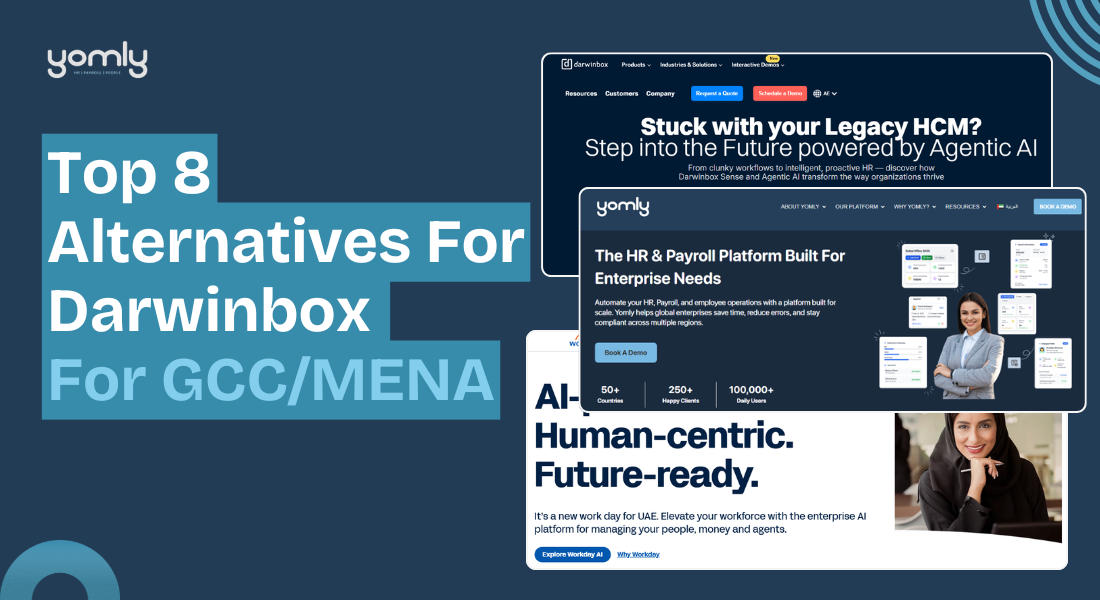
  • Top 8 Alternatives For Darwinbox For GCC/MENA (2026 Updated)

    Top 8 Alternatives For Darwinbox For GCC/MENA (2026 Updated)

    Selecting an HR and payroll system for the GCC and MENA market requires more than choosing a well-known global brand. 

    Darwinbox is a recognised enterprise HCM platform, but some organisations prefer solutions that align more closely with regional payroll rules, compliance standards, and implementation timelines. 

    Companies across the UAE and KSA often evaluate alternatives to find better cost flexibility, simpler rollout, or deeper localisation. 

    In this guide, we review the top Darwinbox alternatives for 2026 and compare them based on regional strength, enterprise capability, and practical deployment fit.

    What is Darwinbox?

    Darwinbox is a cloud-based Human Capital Management platform designed for enterprise and large mid-market organizations. It combines core HR, payroll, recruitment, performance management, workforce management, and employee engagement in one unified system.

    The platform serves 1,000+ companies and over 4 million users across 130 plus countries. It has been recognized as a Strong Performer in The Forrester Wave for HCM solutions and is backed by global investors, including Microsoft.

    Key features of Darwinbox

    • Darwinbox centralizes employee data, reporting structures, salary bands, and compliance tracking across multiple countries in one secure system.
    • HR teams plan increments, bonuses, and merit cycles using structured approval workflows and budget controls.
    • Managers track shifts, attendance, leave balances, and overtime with real-time visibility.
    • The payroll engine supports multi-country processing with built in statutory and localization capabilities.
    • Recruiters manage applicant tracking, offer approvals, and digital onboarding through one connected workflow.
    • The platform enables goal setting, review cycles, skills tracking, and succession planning for critical roles.
    • Leaders access dashboards and reports to monitor headcount, hiring trends, and workforce costs.
    • Employees view payslips, submit leave requests, manage expenses, and access engagement tools through web and mobile access.

    What to look for in a Darwinbox alternative

    Darwinbox offers a broad enterprise HCM suite. However, it may not suit every organisation. Some companies feel the platform becomes complex as more modules are added. HR teams may need training to handle advanced configurations. 

    If you are exploring alternatives, look for:

    • Simpler user experience so HR teams and employees can navigate without extensive training.
    • Faster implementation timelines with lower dependency on IT teams.
    • Flexible reporting tools that allow deep customisation without extra effort.
    • Strong regional compliance support, especially if you operate across GCC or multi-country environments.
    • Transparent and scalable pricing that aligns with your workforce size and growth plans.

    Choosing the right alternative means balancing usability, performance, cost, and regional fit with your long-term HR strategy.

    Best Darwinbox Alternatives in 2026

    1. Yomly, Best Darwinbox alternative for enterprise companies

    Yomly is a cloud-based HR and payroll platform built for enterprise companies in the GCC and MENA region. It is the top alternative for DarwinBox in the GCC and MENA region, which fits enterprise needs without a complex global setup. 

    The company started in 2018 and is based in Dubai. Today, more than 200 enterprise clients use Yomly across 50+ countries, with over 60,000 daily users. Brands like Kärcher, Nord Anglia Education, Isuzu Motors, Halian, and Lufthansa Technik Middle East use Yomly to run HR and payroll at scale.

    Yomly stands out because it is built with regional labor laws in mind. It supports WPS file generation, gratuity calculations, Arabic and English interfaces, and multi-currency payroll without heavy customization. Large HR teams use Yomly to centralize employee records, control approval hierarchies, and track workforce costs by department and entity. Yomly works best for companies with 250 to 500+ employees. It gives HR leaders full control over payroll, compliance, and workforce data across multiple entities.

    Key Features

    • Enterprise Core HR control
      HR teams manage all employee records in one system. They set reporting lines, approval levels, and grading structures that align with the company’s actual setup.
    • GCC-compliant payroll management
      Payroll teams run multi-country payroll using WPS files, perform gratuity calculations, and automate salary adjustments. The system supports UAE and KSA rules out of the box.
    • Automated approval workflows
      The system moves onboarding, confirmations, transfers, and exits through clear approval steps. HR teams track every action without having to chase emails.
    • Smart shift scheduling
      Managers assign shifts, monitor overtime, and receive alerts for consecutive work hours. This reduces manual tracking and payroll errors.
    • Real-time dashboards and reports
      Leaders view headcount data, payroll summaries, and attrition trends in simple dashboards. They make faster decisions with live data.

    Pricing: Custom enterprise pricing based on employee count and selected modules.

    2. Bayzat 

    Bayzat provides a unified HR, payroll, finance, and employee benefits platform built for GCC companies. While Darwinbox delivers a broad global HR suite, Bayzat focuses on strong regional compliance, such as WPS, GOSI, gratuity, and medical insurance administration. Businesses that operate mainly in the UAE or KSA benefit from its localized payroll engine and integrated benefits management.

    The platform connects HR workflows with expense tracking and vendor payments, which Darwinbox does not deeply cover. However, large enterprises with 500+ employees, multi-region entities beyond MENA, or advanced talent strategy needs may find Darwinbox more scalable for complex global deployments.

    Key Features

    • Region-focused payroll compliance: Built in WPS, GOSI, and gratuity calculations tailored for GCC labor laws.
    • Integrated insurance and employee benefits: Manage group health insurance and HR data inside one connected system.
    • HR and finance unification: Combine payroll, expense management, and accounts payable workflows.
    • Mobile first employee experience: Employees access payslips, leave requests, and insurance details through a single app.
    • AI-powered reporting tools: Generate workforce and payroll insights without manual data exports.

    Pricing: Pricing depends on company size, selected modules, and insurance or finance integrations required.

    3. Workday

    Workday serves large enterprises that need deep control over global HR and finance operations. Organizations with complex hierarchies, multiple legal entities, and distributed workforces often consider it alongside Darwinbox when evaluating enterprise HCM platforms.

    Workday stands out for its unified architecture. HR, finance, planning, and analytics run on a single data model, which reduces fragmentation across systems. Its reporting engine and configurable business-process framework enable enterprises to design workflows that align with internal governance structures.

    Key Features

    • Single data model across HR and finance: All workforce and financial data live in one architecture, improving reporting accuracy and cross-functional visibility.
    • Configurable business process framework: Enterprises design approval chains, change workflows, and governance rules without external coding.
    • Enterprise-grade analytics engine: Build calculated fields, custom dashboards, and workforce planning models for executive decision-making.
    • Global compliance readiness: Support multiple currencies, legal entities, and country-specific requirements under one structure.
    • Extensive enterprise integrations: Connect with ERP systems, identity management tools, and third-party payroll providers.

    Pricing: Premium enterprise pricing, generally suited for large organizations with global scale and dedicated HRIS teams.

    4. SAP SuccessFactors

    SAP SuccessFactors is a global HCM suite from SAP that supports large enterprises operating across the GCC and wider MENA region. Companies with 1,000+ employees and multiple legal entities often evaluate it alongside Darwinbox for regional transformation programs.

    SuccessFactors offers strong localization coverage, Arabic language support, and structured compliance management for complex regional workforces. It works well for conglomerates that want standardized HR policies across countries like the UAE, KSA, and Qatar.

    Key Features

    • Localized core HR for MENA operations: Manage employee data, contracts, and country-specific compliance requirements across GCC entities.
    • Integrated talent and performance suite: Align recruitment, performance, and learning processes under one structured enterprise framework.
    • Advanced workforce analytics: Generate cross-country HR reports to support executive-level planning.
    • SAP ecosystem integration: Connect HR data with SAP finance and ERP systems for unified reporting.
    • AI-enabled skills framework: Map workforce capabilities and support strategic talent planning.

    Pricing: Core HR plans start around USD 18 per user per month, with additional costs for talent, payroll, and regional add-ons. Enterprise contracts typically span multiple years.

    5. peopleHum

    peopleHum serves startups and mid-sized companies in the UAE and wider GCC that want structured HR without enterprise-level costs. Teams with 50 to 800 employees often compare it with Darwinbox when they need a simpler rollout and a lower pricing model.

    HR managers can move hiring, attendance, performance, and engagement into one system within weeks. The interface feels modern and mobile-driven, which suits distributed and deskless teams. Its built in analytics help leadership track workforce trends without exporting data into spreadsheets.

    Key Features

    • Quick HR digitization: Replace spreadsheets with structured workflows for hiring, onboarding, and employee records.
    • Mobile attendance and leave controls: Employees clock in, apply leave, and receive reminders directly on their phones.
    • Integrated engagement tools: Run surveys, recognition programs, and internal announcements from one dashboard.
    • Performance and goal tracking: Manage KPIs, review cycles, and 360-degree feedback in a structured format.
    • Built-in HR analytics: Monitor recruitment funnels, engagement scores, and workforce metrics in real time.

    Pricing: Starts at approximately USD 2 per employee per month, with modular add-ons based on selected features and workforce size.

    6. Oracle Fusion Cloud HCM

    Oracle Fusion Cloud HCM from Oracle targets large enterprises across the GCC and MENA that need deep process control and enterprise-wide integration. Government entities, conglomerates, and listed groups often evaluate it alongside Darwinbox during digital transformation programs.

    Oracle stands out for its unified data model across HR, finance, and payroll. Its embedded AI agents, strong analytics, and configurable workflows support complex multi-country operations in the UAE and KSA. It also fits organizations that already run Oracle ERP.

    Key Features

    • Unified HR and finance data layer: Connect workforce data with finance and payroll in one system of record.
    • Enterprise-grade payroll and compliance: Manage multi-country payroll with structured controls and audit visibility.
    • AI embedded talent lifecycle: Use AI agents for recruiting, career development, and workforce planning.
    • Advanced workforce management: Control time, absence, scheduling, and labor optimization within one suite.
    • Oracle ME employee experience platform: Deliver guided journeys, communications, and digital HR support through one interface.

    Pricing: Enterprise subscription pricing is customized based on modules, workforce size, and contract duration. Multi-year agreements are common for GCC deployments.

    7. greytHR

    greytHR becomes a practical alternative to Darwinbox when payroll accuracy and GCC compliance matter more than enterprise-wide HR transformation. Many mid-sized companies in the UAE, Qatar, Oman, Bahrain, and Kuwait switch from complex HCM suites to greytHR to simplify monthly payroll, WPS processing, and statutory deductions.

    Darwinbox positions itself as a broad talent and experience platform. greytHR, in contrast, focuses strongly on payroll control, automated compliance, and cost predictability.

    It fits organizations that want faster implementation and lower per-employee pricing. However, large enterprises that need deep workflow customization or advanced analytics may find the platform less flexible.

    Key Features

    • GCC focused multi-country payroll: Run payroll across UAE, KSA, Qatar, Oman, Bahrain, and Kuwait with automated statutory calculations.
    • WPS and compliance automation: Generate WPS files and government-ready reports directly from the system.
    • Integrated attendance and leave sync: Push attendance, overtime, and leave data directly into payroll without manual adjustments.
    • Employee self-service portal: Employees access payslips, tax details, and leave balances from the web and mobile.
    • Modular add-ons: Add recruitment, performance, or expense modules as business needs grow.

    Pricing: Starts at USD 50 per month for 10 employees, with additional per-employee charges based on the selected plan tier.

    8. ZingHR

    ZingHR is an enterprise-grade HR platform built for Middle East organizations that want structured governance, AI-led insights, and strong payroll control in one system. It serves large and upper mid-market companies across the UAE and MEA that manage complex workforce structures and multi-location operations.

    The platform focuses on measurable business outcomes. Leadership teams use it to connect HR data with financial visibility, audit tracking, and compliance oversight. It suits organizations that prefer outcome-driven HR management over basic automation.

    Key Features

    • Hire-to-rehire enterprise coverage: Manage recruitment, onboarding, payroll, performance, succession, and exit in one connected platform.
    • AI-driven HR analytics: Use predictive insights and configurable dashboards for workforce and financial decisions.
    • Real-time payroll cockpit: Monitor payroll processing, budgeting, and compliance from a centralized control view.
    • Compensation and merit planning: Simulate increments, align ratings with budgets, and push approved changes into payroll.
    • Governance and audit controls: Enable maker-checker workflows, structured approvals, and traceable audit trails.

    Pricing: Enterprise subscription pricing is customized based on modules, employee count, and regional rollout scope across MEA.

    How Yomly Compares to Darwinbox

    Yomly and Darwinbox both serve growing enterprises, but they approach HR transformation differently. Darwinbox offers a broad, global HCM suite designed for large-scale digital programs. Yomly focuses sharply on enterprise needs across the GCC, where compliance, payroll accuracy, and regional alignment matter most.

    Yomly delivers deep localisation for UAE and GCC labour laws, built-in WPS processing, and workflows designed for regional complexity. It reduces configuration effort and speeds up implementation without sacrificing enterprise control.

    For organisations operating in the Middle East, Yomly provides stronger regional expertise, clearer payroll governance, and a more practical path to scalable HR transformation.

    CriteriaYomlyDarwinbox
    Primary FocusGCC and MENA enterprise HR and payrollGlobal enterprise HCM platform
    Ideal Company Size250 to 5000+ employeesMid to large global enterprises
    Regional ComplianceDeep GCC localisation with UAE WPS, labour law alignmentMulti-country compliance with global coverage
    Payroll StrengthStrong GCC payroll engine with region-specific controlsUnified payroll with multi-country capabilities
    ImplementationFaster rollout with regional expertiseStructured enterprise implementation may take longer
    CustomisationConfigurable workflows tailored for GCC operationsHighly customisable enterprise framework
    User ExperienceClean interface built for HR and managersFeature-rich interface with broader modules
    Best ForEnterprises operating across the GCC that need tight compliance controlOrganisations managing a distributed global workforce

    ???? Book a free demo with Yomly to see how a GCC-focused platform can simplify your enterprise HR and payroll at scale.

    Final verdict

    This comparison is not about replacing one global HCM with another. It is about finding the right regional fit for GCC and MENA organisations.

    Darwinbox is a strong enterprise HCM platform, but it may not align with every GCC or MENA organisation. Some companies need lighter implementation, deeper local payroll alignment, or more cost control.

    Global suites like Workday, Oracle Fusion Cloud HCM, and SAP SuccessFactors suit complex multinational structures. Bayzat and greytHR work well for companies prioritising payroll efficiency and compliance in the UAE and KSA. ZingHR and peopleHum appeal to businesses that want structured HR with a simpler rollout.

    The best option depends on your workforce size, compliance exposure, and internal HR maturity. For enterprises seeking strong GCC localisation with enterprise-grade control, Yomly remains a compelling region-focused choice.

  • How Enterprise HR Automate Employee Onboarding Workflows

    How Enterprise HR Automate Employee Onboarding Workflows

    Most companies begin onboarding with emails, spreadsheets, and manual checklists. Large enterprise teams move beyond that. They design structured workflows where HR triggers the process, systems execute tasks automatically, and IT only handles exceptions.

    Below is how mature organizations automate onboarding in a practical and scalable way.

    1. HR as the System of Record

    Enterprise automation always starts with one principle: HR owns employee data.

    When HR enters a new hire into the HR system with core details such as name, department, job title, reporting manager, employment type, and start date, that entry becomes the master identity record.

    From there, systems pull information automatically.

    As one sysadmin described on Reddit:

    This removes guesswork. IT does not wait for informal emails. Payroll does not re enter the same data. Security does not chase confirmations. Everything flows from one trusted source.

    Without a single source of truth, onboarding automation will always break.

    2. Role Based Access Instead of Manual Permission Copying

    In less structured environments, IT copies access from another employee and adjusts it manually. This creates errors and often grants too much access.

    Enterprise teams define roles in advance. Each role includes predefined access rules based on job function and department.

    For example, a Finance Analyst and a Sales Executive do not receive the same access bundle. Their system permissions, security groups, reporting dashboards, and collaboration tools are pre mapped to their role.

    3. Automated Account Provisioning Across Systems

    Once HR data is validated, automation handles account creation across multiple systems at the same time.

    Instead of IT creating accounts one by one, the workflow engine provisions:

    • Directory account
    • Corporate email
    • Collaboration platform access
    • VPN profile
    • Application licenses

    In many enterprises, identity management platforms such as Microsoft Identity Manager or Okta coordinate these actions. In other cases, custom automation scripts run on a schedule and compare HR records with system accounts.

    The goal is simple. On day one, the employee logs in without delays. IT does not scramble to create accounts at the last minute.

    4. Workflow Routing for Cross Department Tasks

    Onboarding does not involve IT alone. A new hire may need payroll setup, ID card creation, laptop allocation, system access, workspace preparation, and compliance documentation. Without structure, these steps get lost in email threads and informal follow ups.

    Efficient enterprises solve this with workflow routing systems. When HR submits a new hire entry, the platform automatically creates linked tasks for IT, finance, facilities, and security. Each team receives clear instructions and deadlines inside the system.

    Progress is tracked centrally. Delays are visible. Escalations happen automatically.

    5. Start Date Driven Activation

    Security is critical in enterprise environments because account access directly connects to payroll data, financial systems, customer information, and internal tools. If accounts are activated too early, organizations expose themselves to unnecessary risk. If they are activated too late, the employee’s first day becomes unproductive.

    Mature onboarding systems solve this by separating account creation from account activation.

    Here is how it typically works:

    HR enters the employee into the system with a confirmed start date. The identity management engine immediately creates the digital identity. This includes directory account, email profile, system group assignments, and application provisioning. However, the account remains in a disabled state.

    The automation engine continuously monitors the employment start date field. At a predefined time, often midnight or early morning on the joining date, the system automatically enables the account. No manual login by IT is required.

    This approach offers multiple advantages:

    • IT can prepare everything in advance without rushing.
    • Managers avoid last minute access delays.
    • Security teams reduce the risk of premature access.
    • Audit logs clearly show when access was granted.

    If the start date changes, the automation logic adjusts accordingly. If the offer is withdrawn, the account never activates. If onboarding is postponed, access remains blocked until the updated date.

    This creates a balance between readiness and control. The employee logs in on day one with full access, but the organization never grants permissions before it should.

    6. Controlled Approvals for Sensitive Access

    Not every permission should be automatic.

    For roles involving finance, payroll, or administrative privileges, enterprise onboarding systems include approval checkpoints. Managers select required access, and system owners approve or reject requests through structured workflows.

    This balances speed with governance. Automation handles standard access. Humans approve of exceptions.

    7. Integration with HRMS and Payroll Platforms

    True onboarding automation does not stop at IT systems. It connects directly with HR and payroll platforms.

    Enterprise HR systems such as Yomly centralize employee lifecycle management. When onboarding is integrated into such platforms:

    • Employee profiles are created once
    • Salary structures are assigned automatically
    • Leave policies are configured based on role
    • Approval workflows are linked to managers

    This reduces duplicate data entry and prevents payroll inconsistencies. HR teams manage onboarding inside one secure platform instead of coordinating across disconnected tools.

    Automation becomes part of the broader workforce management strategy, not just an IT process.

    8. Secure Credential Distribution and Notifications

    Once onboarding steps are complete, automated notifications inform HR and hiring managers.

    Modern systems avoid sending plain text passwords. Instead, they use secure activation links or self service portals where employees set their own credentials.

    This strengthens security and improves the employee experience.

    9. Lifecycle Automation Beyond Onboarding

    Enterprise teams design onboarding as part of the full employee lifecycle.

    The same automation engine manages promotions, department transfers, and terminations. When job roles change, access recalculates automatically. When termination dates are entered, accounts disable without manual intervention.

    This prevents orphan accounts and ensures compliance across the organization.

    What Makes Enterprise Onboarding Efficient

    Efficient onboarding depends on structured workflows, centralized data, and role driven automation. HR acts as the source of truth. Systems calculate access. Workflows assign tasks. Payroll and HR platforms integrate seamlessly.

    When done correctly, onboarding shifts from reactive setup to predictable, controlled, and scalable execution.

  • 10 Underrated AI Use Cases in Enterprise HR Systems

    10 Underrated AI Use Cases in Enterprise HR Systems

    Most enterprise HR teams use AI for drafting emails or summarizing meetings. That barely scratches the surface.

    Enterprise HR systems store massive structured and unstructured data. The real opportunity is using AI to extract insight, reduce operational waste, and improve decision quality.

    Below are underrated AI use cases in enterprise HR systems, explained in depth.

    1. Workflow Defect and Bottleneck Analysis in HR Operations

    Every action inside an HR system leaves a digital trail.

    When a manager submits a salary change request, the system logs:

    • Submission time
    • Reviewer comments
    • Approval or rejection
    • Payroll processing
    • Final confirmation

    In one Reddit discussion, a professional used Google AI Studio to analyze thousands of HR workflow records and generate a structured process improvement report. The AI identified fault percentages, delays, and recurring rejection reasons.

    Most HR teams never calculate internal defect rates.

    AI can help answer:

    • Which step causes the most delays
    • Which departments submit incomplete forms
    • How long each workflow stage takes on average
    • Where compliance violations occur

    Yomly already centralizes HR workflows such as leave approvals, salary structure changes, payroll approvals, and document issuance. 

    Since actions are logged with timestamps and user data, this structured dataset becomes ideal for AI based workflow analysis.

    ???? Try Yomly’s HR software built for enterprises Businesses 

    2. Large Scale Policy Drafting and Gap Identification

    Enterprise organizations operate across regions with different labor laws and compliance standards. Policies must be consistent yet adaptable.

    AI can:

    • Compare existing policies against regulatory standards
    • Highlight missing clauses
    • Suggest clearer language
    • Standardize formatting across global documents

    For example, during a merger, HR may need to align leave policies across three regions. Instead of manually reviewing hundreds of pages, AI can summarize differences and suggest alignment points.

    The value here is speed and structure. AI generates first drafts and comparison summaries. HR validates legal accuracy and makes final decisions.

    This significantly reduces policy development time without removing human oversight.

    However, even the most advanced AI systems fail when employees cannot easily navigate HR platforms or access information quickly. A well planned enterprise UX design strategy helps organizations improve usability, reduce employee frustration, and increase adoption across HR systems.

    3. Performance Review Pattern Detection and Bias Monitoring

    Performance reviews generate large volumes of qualitative data. HR teams often focus only on final ratings, not language patterns.

    AI can analyze:

    • Tone differences across managers
    • Overuse of vague praise
    • Gendered language patterns
    • Inconsistent rating distributions

    For example:

    If one manager consistently gives high ratings with minimal explanation, while another provides detailed but harsh feedback, AI can flag this inconsistency before calibration meetings.

    This helps HR:

    • Reduce bias
    • Improve fairness
    • Support structured calibration discussions
    • Identify training needs for managers

    This is far more strategic than using AI to simply draft review comments.

    4. Meeting Transcripts Into Structured Operational Assets

    Many HR leaders record meetings and stop at summaries.

    The deeper value lies in transformation.

    AI can convert long meeting transcripts into:

    • Formal meeting minutes
    • Clear action trackers with owners and deadlines
    • Standard Operating Procedures
    • Risk logs
    • Policy drafts

    For example:

    A two hour workforce planning meeting can be converted into a structured document that outlines headcount decisions, hiring freezes, risk flags, and next steps.

    Platforms integrated within enterprise ecosystems, such as solutions within Microsoft 365, allow transcript analysis inside secure environments.

    This reduces confusion and improves execution consistency across departments.

    Turn HR decisions into real system changes. See how Yomly helps you configure workflows, payroll rules, and approvals with full control.

    ???? Book a demo to connect strategy with execution.

    5. Enterprise Knowledge Retrieval Across HR Systems

    Large companies operate multiple systems:

    • HRIS platforms
    • Internal wikis
    • Policy repositories
    • Learning portals
    • Compliance documentation

    Employees often submit HR tickets because they cannot find information.

    AI powered internal chatbots trained on company knowledge bases can answer complex questions such as:

    • How does the relocation policy apply to international transfers
    • What is the eligibility criteria for grade level adjustments
    • Which training is mandatory for managers

    Instead of browsing multiple platforms, employees receive structured answers instantly.

    This reduces repetitive HR queries and improves employee experience.

    6. Proactive Meeting Preparation for HR Business Partners

    HR Business Partners handle multiple stakeholders across business units.

    AI agents can review:

    • Previous meeting notes
    • Open employee relations cases
    • Attrition data
    • Performance trends
    • Pending approvals

    Before a leadership meeting, the HRBP receives a structured brief summarizing:

    • Current workforce risks
    • Policy violations
    • Compensation anomalies
    • Engagement concerns

    This improves the quality of conversation and positions HR as data driven rather than reactive.

    7. Internal Audit Simulation and Compliance Stress Testing

    Enterprise HR departments face frequent audits.

    AI can simulate auditor behavior by reviewing:

    • Policy documents
    • Control frameworks
    • Approval logs
    • Documentation trails

    It can then:

    • Flag missing evidence
    • Suggest documentation improvements
    • Generate standard response templates

    This allows HR teams to identify weaknesses before official audits begin.

    The benefit is preparation and risk reduction, not automation of compliance decisions.

    8. Structured Recognition and Communication at Scale

    Some leaders experiment with AI generated recognition messages, including video personalization tools like HeyGen.

    The real value is not automation of praise. It is structured recognition tracking.

    AI can:

    • Identify high performing employees from project data
    • Draft personalized recognition messages
    • Ensure recognition language aligns with company values
    • Track recognition frequency across departments

    HR can also analyze recognition distribution to ensure fairness and inclusion.

    The technology must be used carefully. Authentic leadership cannot be replaced, but AI can support consistency and visibility.

    9. Synthetic Data Modeling for Secure Analytics

    HR systems store salary data, performance ratings, disciplinary records, medical leave details, diversity information, and investigation notes. Uploading this data into public AI tools creates legal exposure and trust risk. In many organizations, it is strictly prohibited.

    This is where synthetic data modeling offers a practical solution.

    Synthetic data is artificially generated data that mirrors the structure and behavior of real HR data but does not contain information about actual employees.

    For example, instead of using actual payroll records, an HR analytics team can generate a dataset that includes job grades, salary bands, department codes, tenure ranges, and performance scores. The numbers follow logical patterns, but they are fictional.

    Using this synthetic dataset, HR teams can build and test:

    • Attrition prediction models.
    • Compensation equity dashboards.
    • Performance distribution reports.
    • Automation scripts for recurring analysis.
    • Workforce planning simulations.

    Once the model or dashboard works correctly, the final logic can be deployed inside secure enterprise systems using real data under controlled access.

    10. Early Risk Detection Through Language and Sentiment Analysis

    Traditionally, HR focuses on numeric scores and reviews only a small portion of comments. Manual review of thousands of responses is not practical. Important patterns often remain hidden until attrition rises or formal complaints escalate.

    AI driven language analysis changes this.

    Natural language models can scan large volumes of text and identify recurring themes, tone shifts, and emotional patterns. They can detect increases in words associated with stress, frustration, or burnout. They can identify repeated mentions of a specific manager, policy, or department. They can cluster similar complaints across regions or job levels.

    For example, if exit interviews from a particular team repeatedly mention unclear career progression, AI can surface that trend early. If engagement comments increasingly reference long hours and workload pressure in a certain function, HR can investigate before turnover increases.

    Final thoughts

    AI in enterprise HR is not about faster emails. It is about smarter decisions from structured data. When paired with a strong foundation like Yomly, AI turns payroll, workflows, and workforce data into real strategic advantage.

  • Remote HR Roles in Large Organizations: What to Expect

    Remote HR Roles in Large Organizations: What to Expect

    Remote HR roles in large organizations can give you stability and focus. But they also come with structure, slower decision cycles, and less control over how things are built.

    Here is what the role really looks like in practice.

    1. Your role will be highly specialized

    In large organizations, HR is divided into clear functions. You are not expected to do everything.

    You may work only in:

    • Employee relations
    • Talent acquisition
    • HR operations
    • Compensation and benefits
    • HR analytics
    • Learning and development

    At companies like Amazon, HR is split into multiple teams. One team handles recruiting. Another handles exits. Another manages data. Another supports business leaders.

    This setup reduces the generalist burden. You focus on your function and build deep expertise.

    However, you may not get exposure to the full HR lifecycle. If you enjoy variety and ownership across many areas, this structure can feel narrow.

    2. Change does not disappear in large companies

    Many people assume large companies are calm and stable. That is not always true.

    Large organizations go through:

    • Leadership changes
    • Mergers and acquisitions
    • Restructuring
    • Policy updates
    • System migrations
    • Layoffs

    The difference is how change happens. In startups, change feels chaotic and urgent. In large firms, change is planned, documented, and rolled out in phases.

    One senior HR professional in a Fortune 100 company shared on Reddit that leadership philosophy shifts every few years. Each shift changes how HR operates.

    So remote HR roles in large firms still require adaptability. The pace may be slower, but the volume of change remains high.

    3. You may experience siloed work

    Large companies often use a three layer HR model:

    • Centers of Excellence design policies
    • HR Business Partners implement them
    • Shared Services handle transactions

    This model increases consistency across locations.

    But it also limits autonomy.

    If you are an HRBP, you may not design a compensation strategy. A global compensation team decides that. You execute within their framework.

    If you are in shared services, you may follow strict process guidelines with little room for adjustment.

    This can reduce creativity. Decisions require alignment across multiple teams. Change moves slowly because many stakeholders must approve it.

    4. Remote setup changes how you build influence

    In large organizations, your manager or business leaders may sit in another city or country.

    You may support a unit of 200 employees without ever meeting them in person.

    This creates challenges:

    • You must build trust through video calls
    • You must rely on data to support decisions
    • You must document conversations clearly
    • You must follow up consistently

    Influence becomes more structured. You cannot rely on hallway conversations or informal chats.

    Strong communication skills become critical. Clear emails, structured presentations, and data backed arguments help you gain credibility.

    Remote HR roles reward professionals who are organized and proactive.

    5. Workload can still be heavy

    Many assume that large companies mean large HR teams. That is not always true.

    Even in organizations with 15,000 or 100,000 employees, HR departments often run lean.

    You might be:

    • The only employee relations partner for several business units
    • The sole HRBP for a specific region
    • The only person handling investigations for a department

    When someone resigns, responsibilities shift quickly. Hiring replacements can take time due to internal approval processes.

    So while the structure is bigger, the workload can still feel intense.

    The difference is that responsibilities are clearer, not necessarily lighter.

    6. Career growth is more structured

    Large organizations usually offer defined career paths.

    You can see:

    • Job grades
    • Promotion criteria
    • Internal mobility programs
    • Leadership development tracks

    If you want to become a Subject Matter Expert in employee relations or compensation, large firms allow deep specialization.

    You also gain brand credibility. Experience at a known company can strengthen your resume.

    Many HR professionals move to large firms specifically to build credibility and structured growth.

    7. Politics and hierarchy are stronger

    Large organizations have multiple leadership layers.

    You may report to a Senior HRBP who reports to a Director who reports to a VP.

    Each leader may have a different management style.

    Some leaders focus on compliance. Others prioritize operations. Others focus on employee experience.

    This creates complexity.

    Remote roles can increase this challenge because communication happens mostly through calls and email. Misalignment can happen easily if documentation is weak.

    You must understand formal escalation channels. You must protect yourself through clear written communication.

    Politics are not always negative, but they require maturity and emotional control.

    8. Stability can be a major advantage

    Large companies usually handle economic downturns better than startups.

    They have:

    • Larger cash reserves
    • Diversified revenue streams
    • Established processes

    There may still be layoffs. But large firms often restructure instead of shutting down entirely.

    For professionals with families or financial commitments, this stability matters.

    Remote roles in large companies also offer geographic flexibility. You can work for a global firm without relocating.

    Who benefits most from remote HR roles in large organizations?

    This path works well if you:

    • Prefer structure over constant firefighting
    • Want clear boundaries in your role
    • Enjoy building deep expertise
    • Value job security
    • Are comfortable working through systems

    It may not fit if you:

    • Want full ownership of HR strategy
    • Enjoy fast decision making
    • Prefer direct daily interaction with executives
    • Get frustrated with layered approvals

    Remote HR roles in large organizations are not easier. They are more structured. You gain clarity and scale.

    You lose some flexibility and speed. Your satisfaction depends on whether you value stability or autonomy more at this stage of your career.

    Further resources: 

    Final Thoughts

    If your organization operates in the GCC and manages a large workforce, the right HR system must support local compliance, payroll accuracy, and enterprise scale.

    Yomly is built specifically for this environment. It combines regional expertise with modern cloud technology to help HR and finance teams reduce manual work and gain better visibility across operations.

    For enterprises that need secure, bilingual, and compliance ready HR and payroll software, Yomly offers a practical and scalable solution.

    You can explore the platform and request a personalized demo to see if it aligns with your operational goals.